Looking for real tensile structure examples before you plan a canopy, stadium roof or parking shed? Studying famous projects is the fastest way to understand what fabric architecture can actually do. In this guide we walk through 15 well-known tensile structure examples from Europe, the Middle East, Asia and the Americas, explain the engineering idea behind each one, and show which lessons apply to everyday projects in Pakistan, from a school canopy to a petrol pump forecourt.
Every project below uses the same basic principle: a thin membrane or cable net is pulled into tension, curved into a stable shape, and anchored to masts, arches, edge cables or a ring beam. Because the fabric only carries tension (never compression or bending), the structure can span huge distances with very little material. That is why tensile structure examples range from 3-metre shade sails to roofs that cover entire stadiums.
What Makes a Good Tensile Structure Example?
Before the list, it helps to know what engineers look for when they call a project a landmark. The best tensile structure examples share four qualities:
- A clear structural form. Saddle (hypar), cone, arch or cushion shapes that carry load efficiently.
- The right membrane for the climate. PTFE-coated glass fibre for desert heat, ETFE cushions for daylight, PVC-coated polyester for cost-sensitive work.
- Honest detailing. Visible masts, cables and plates that explain how forces travel to the ground.
- Long service life. Many of the projects below have been in use for 25 to 50 years.
If you are new to the different families of forms, read our guide to the types of tensile structures first, then come back to see each type in real buildings.
15 Famous Tensile Structure Examples Around the World
1. Olympic Park Roof, Munich, Germany (1972)
Designed by Günter Behnisch with Frei Otto, the Munich Olympic roof is the project most students meet first. A vast cable net covered with acrylic glass panels flows over the stadium, arena and swimming hall like a transparent landscape. Frei Otto tested the shapes with soap-film and physical models long before computer form-finding existed.
Lesson for owners: form-finding comes first. A tensile roof is shaped by forces, not drawn freehand, which is why reliable suppliers model every canopy before cutting fabric.
2. German Pavilion, Expo 67, Montreal, Canada
Also by Frei Otto (with Rolf Gutbrod), this pavilion used a pre-stressed cable net with a hanging membrane supported by eight masts of different heights. It proved that a lightweight, demountable building could look permanent. It is one of the earliest modern tensile structure examples and inspired the Munich roof.
Lesson: high and low points create the double curvature that keeps fabric stable and stops flutter in the wind.
3. Hajj Terminal, King Abdulaziz International Airport, Jeddah, Saudi Arabia (1981)
Designed by Skidmore, Owings & Merrill with engineer Fazlur Rahman Khan and fabric specialist Horst Berger, the Hajj Terminal shelters pilgrims under hundreds of thousands of square metres of PTFE-coated glass fibre arranged as repeating tent cones. It received the Aga Khan Award for Architecture and is still one of the largest fabric roofs ever built.
Lesson: in a hot climate, a translucent white membrane reflects most of the sun’s heat while letting soft daylight through. The space stays cooler and brighter than under a metal sheet, with natural ventilation rising through the cone tops.
4. Masjid an-Nabawi Umbrellas, Madinah, Saudi Arabia
The courtyards of the Prophet’s Mosque are shaded by 250 giant retractable umbrellas made with PTFE fabric, engineered by SL Rasch. They open in the morning to protect worshippers from the sun and fold away in the evening so the courtyard can cool down under the open sky.
Lesson: tensile shading does not have to be fixed. Retractable and convertible systems are ideal where heat by day and cool air by night both matter.
5. Denver International Airport, Jeppesen Terminal, USA (1995)
The white peaks of the Denver terminal echo the snow-capped Rocky Mountains. Fentress Architects worked with Horst Berger on a double-layer PTFE fabric roof that lets daylight into the great hall and cuts the need for artificial lighting.
Lesson: fabric can be insulated. A two-layer membrane with an air gap improves thermal performance, an approach that suits halls and showrooms that need comfort, not just shade.
6. The O2 (Millennium Dome), London, UK (1999)
Richard Rogers and Buro Happold created a 365-metre-wide dome of PTFE-coated glass fibre held up by twelve yellow masts and a network of steel cables. It is often quoted as one of the largest single-roof tensile structure examples in the world, and it is now a leading concert venue.
Lesson: masts and cables can carry a giant roof with very few columns inside, which gives completely open floor space. The same idea works at a smaller scale for warehouses, sports halls and event spaces.
7. Eden Project, Cornwall, UK (2001)
Nicholas Grimshaw’s biomes are geodesic frames filled with inflated ETFE cushions. ETFE weighs only a small fraction of equivalent glass, so the steel frame could be very light, while the cushions let in the ultraviolet light that plants need.
Lesson: ETFE is the answer when maximum light transmission matters. Our PTFE vs ETFE comparison explains when each membrane makes sense.
8. Allianz Arena, Munich, Germany (2005)
Herzog & de Meuron wrapped the stadium in roughly 2,800 diamond-shaped ETFE cushions that can be lit in different colours. The façade is a famous example of a membrane used as branding as well as weather protection.
Lesson: fabric and foil surfaces can carry lighting and colour, turning a building into a landmark at night.
9. Beijing National Aquatics Centre (“Water Cube”), China (2008)
The Water Cube’s soap-bubble façade is made from ETFE cushions on a steel space frame. It showed the world that membrane architecture could be both playful and highly energy-efficient, capturing solar heat to warm the pools.
10. Khan Shatyr Entertainment Centre, Astana, Kazakhstan (2010)
Foster + Partners designed a giant transparent tent of ETFE suspended from a central mast. Inside, visitors enjoy a warm indoor climate even when the outside temperature falls far below freezing.
Lesson: a tensile envelope can create its own microclimate, keeping heat out in summer or holding warmth in winter.
11. King Fahd International Stadium, Riyadh, Saudi Arabia (1987)
The stadium roof is a ring of fabric “tents” suspended from masts around the bowl, giving shade to spectators while leaving the pitch open. It is a classic tensile structure example for sports venues in hot countries.
Lesson: for stands, terraces and pavilions, a cantilevered or mast-supported canopy shades people without blocking views.
12. Canada Place, Vancouver, Canada (1986)
Five white fabric “sails” rise above this waterfront convention centre and cruise terminal. They have become a symbol of the city and show how fabric roofs can survive coastal wind, rain and salt air when they are well detailed.
13. Sidney Myer Music Bowl, Melbourne, Australia (1959)
An early tensioned roof using a cable net with a lightweight covering, spanning a large outdoor amphitheatre from two tall masts. It proves how long a well-maintained tensile structure can stay in service.
14. Tokyo Dome, Japan (1988)
Nicknamed the “Big Egg”, the Tokyo Dome has an air-supported roof of PTFE-coated glass fibre. Slight air pressure inside the stadium holds the membrane up, so no columns or masts block the view of the field. It is one of the best-known air-supported tensile structure examples.
Lesson: tension can come from air pressure as well as from masts and cables. Inflated forms suit very large clear spans and temporary or seasonal halls.
15. Everyday Tensile Structure Examples in Pakistan
Not every project needs to be famous to be useful. Some of the most valuable tensile structure examples are the ones we see daily:
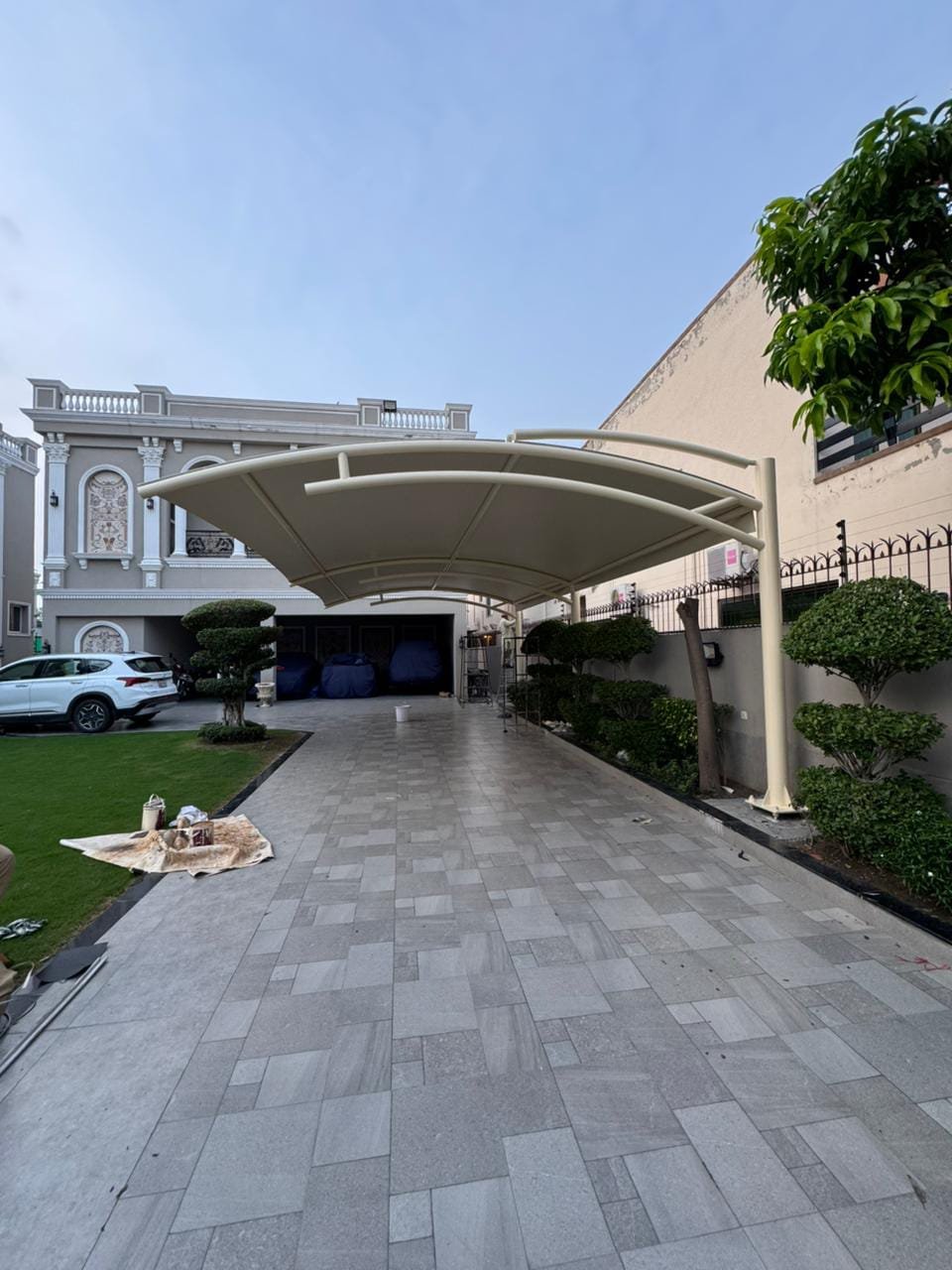
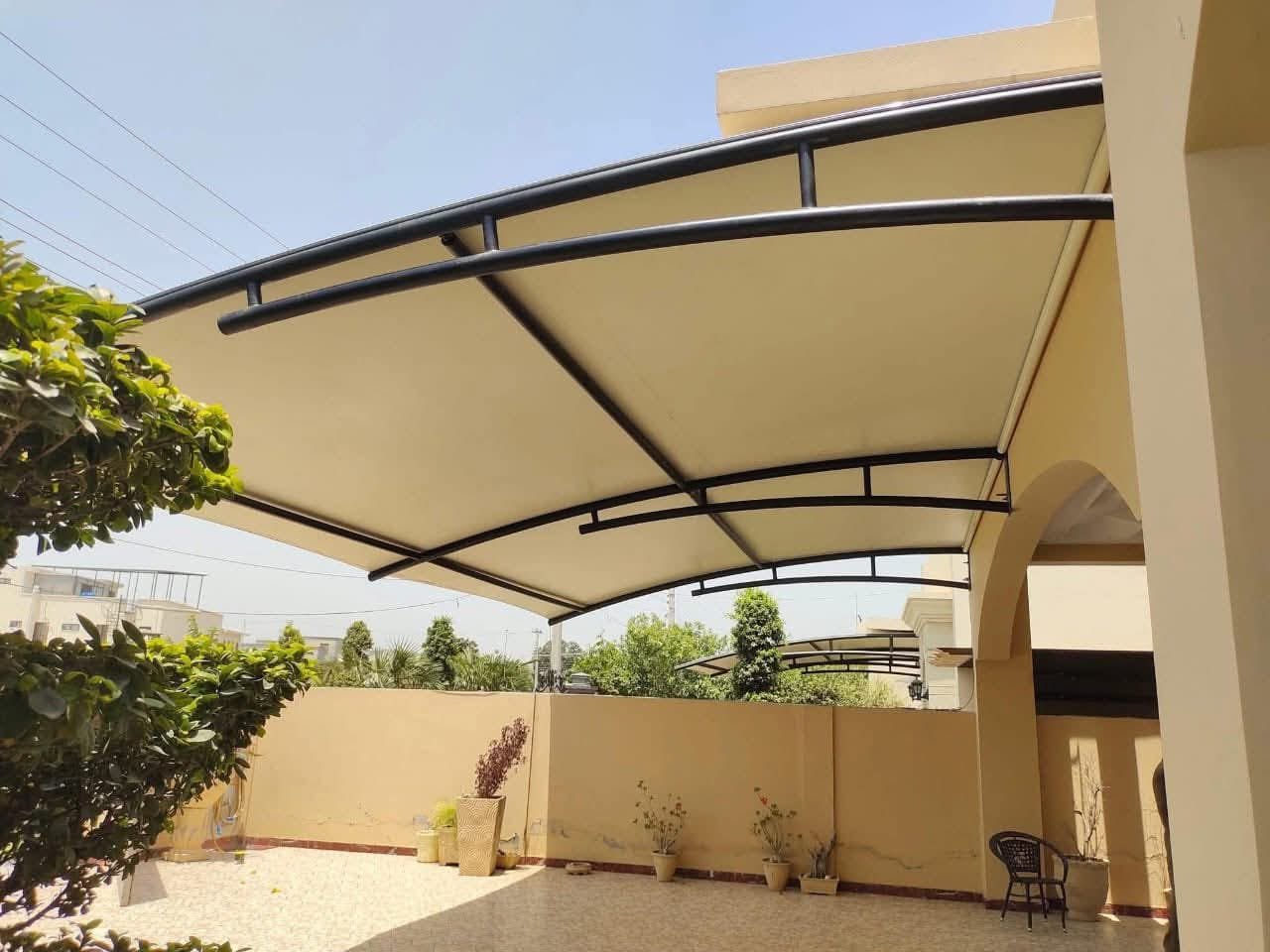
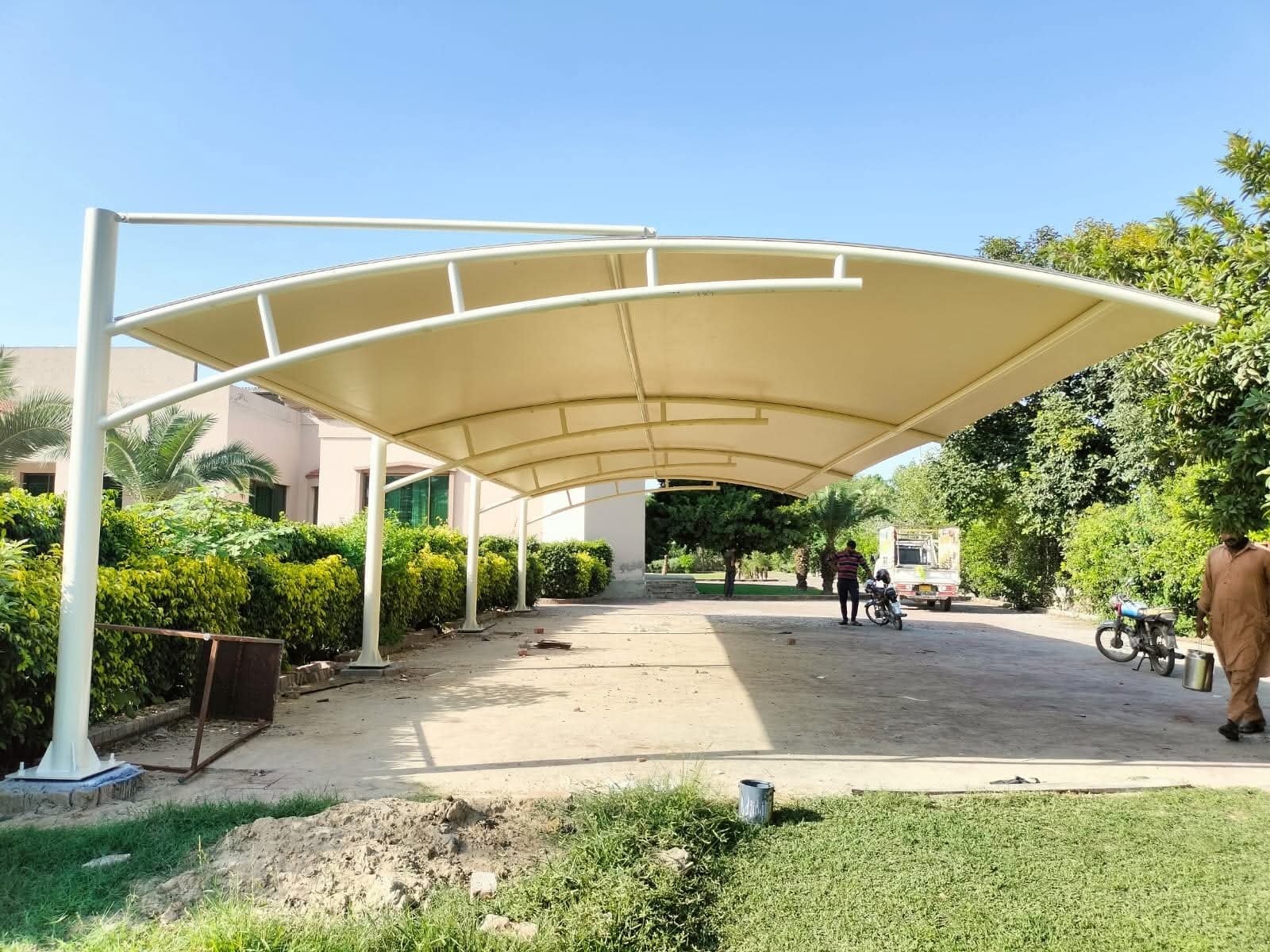
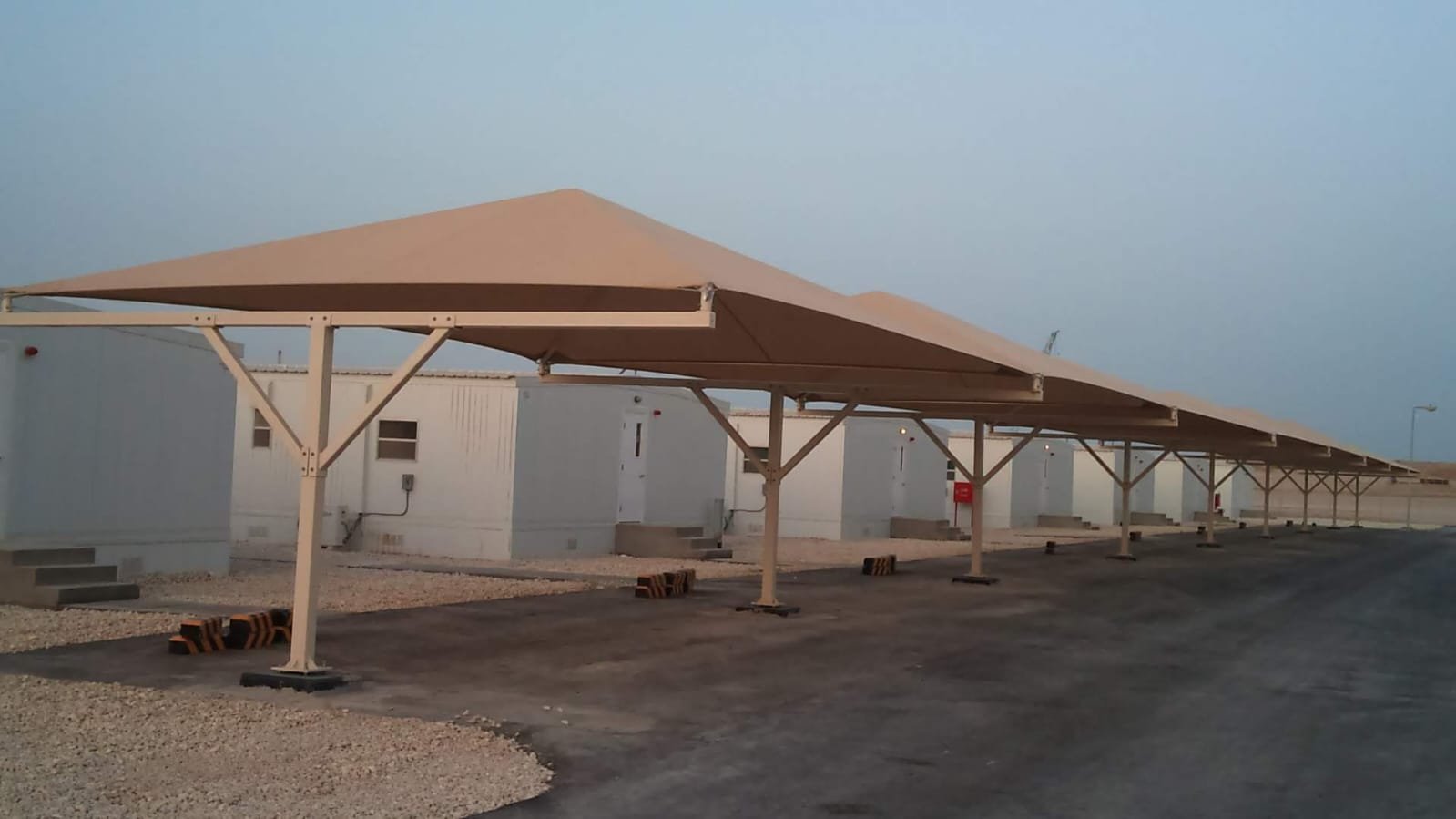
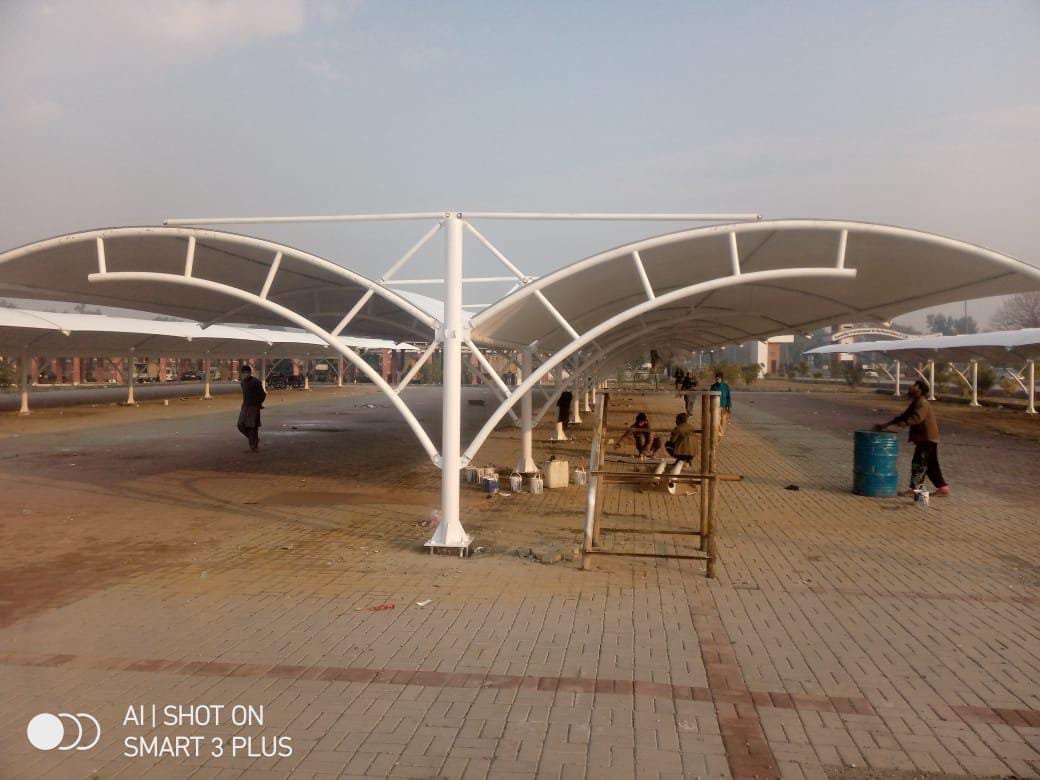
- Car parking sheds at hospitals, offices and housing societies
- Petrol pump and CNG station forecourt canopies
- School and university courtyard shades
- Restaurant and café outdoor seating canopies
- Walkway covers, gazebos and rooftop shades
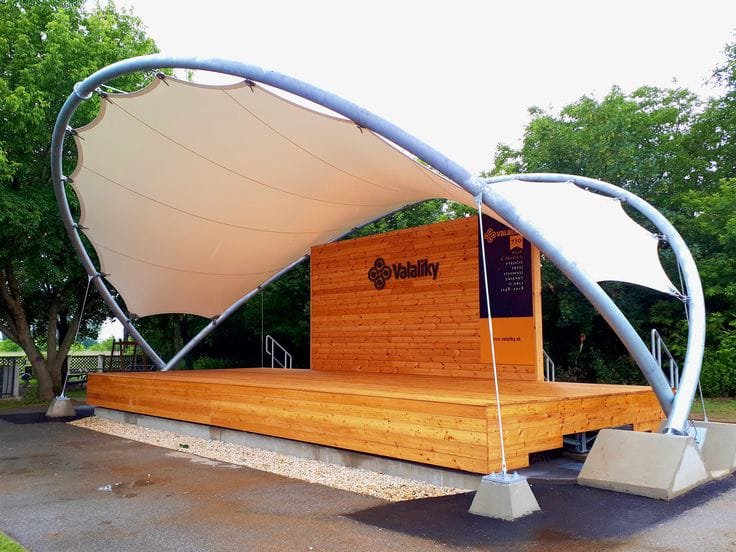
- Stage covers and event pavilions
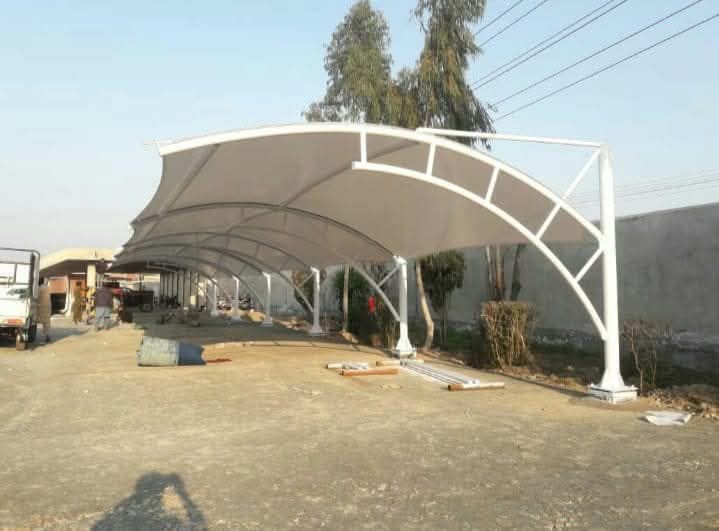
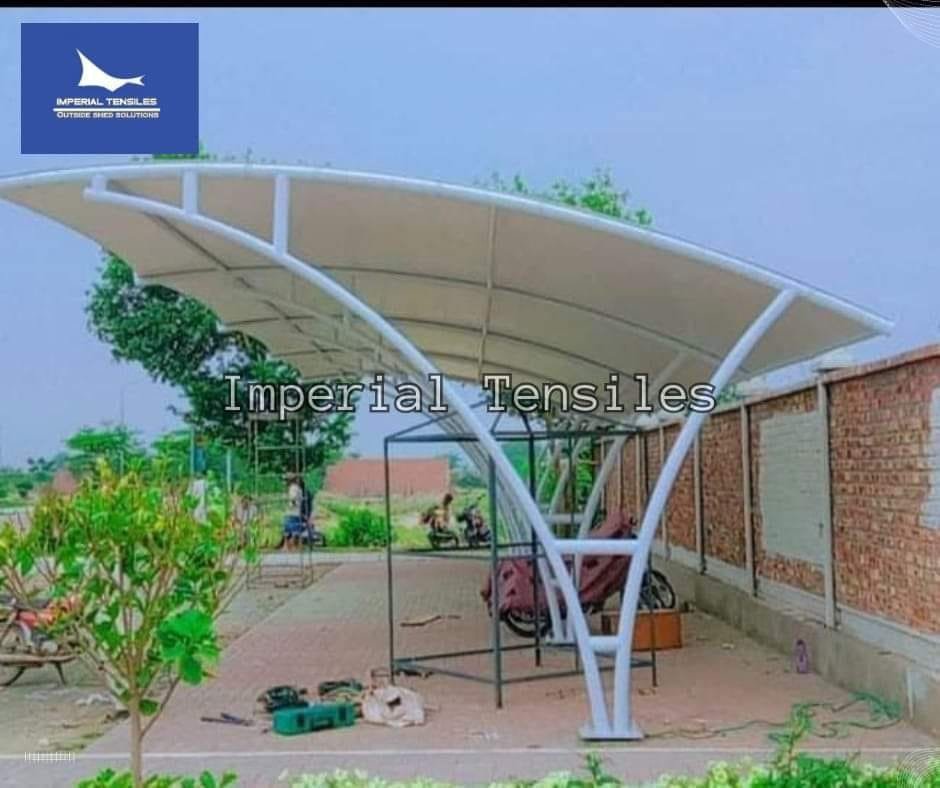
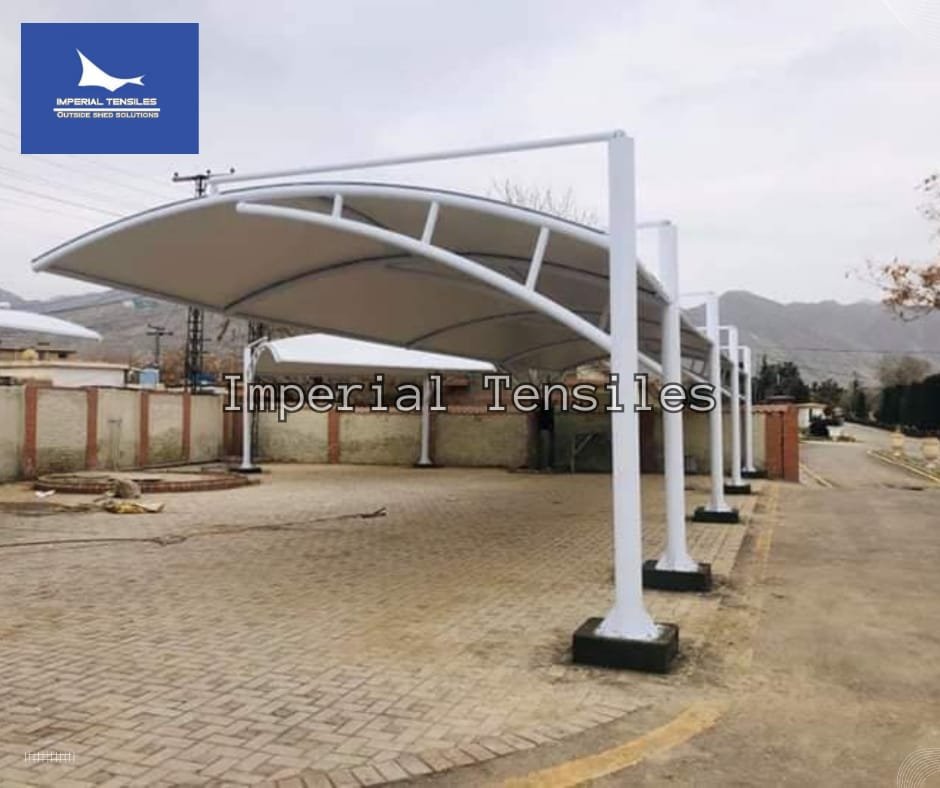
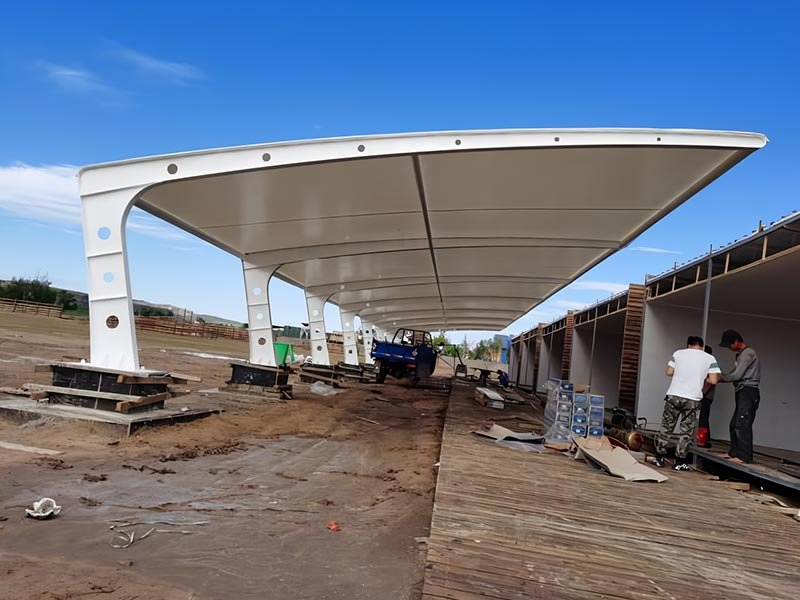
These projects use the same physics as the Hajj Terminal or the O2, just at a smaller scale. A properly designed car parking shed is, structurally, a mini stadium canopy.
Comparison Table: Membrane Used in Famous Projects
| Project | Country | Main material | Structural system |
|---|---|---|---|
| Munich Olympic Park | Germany | Acrylic panels on cable net | Cable net with masts |
| Hajj Terminal | Saudi Arabia | PTFE-coated glass fibre | Repeating cone tents |
| Denver Airport | USA | PTFE glass fibre, two layers | Ridge and valley peaks |
| The O2 | UK | PTFE glass fibre | Mast-supported cable dome |
| Eden Project | UK | ETFE cushions | Geodesic frame |
| Allianz Arena | Germany | ETFE cushions | Façade cushions |
| Khan Shatyr | Kazakhstan | ETFE | Mast-hung tent |
| Masjid an-Nabawi umbrellas | Saudi Arabia | PTFE fabric | Retractable umbrellas |
Key Design Lessons from These Tensile Structure Examples
Shape Comes from Forces
Every landmark on this list was form-found. Engineers balance the pre-stress in the fabric with its curvature so the surface stays tight. A flat piece of fabric is never stable; a properly curved one is. When you look at quotations, ask whether the supplier models the shape in tensile software and checks pre-stress, not just steel sizes.
Material Choice Is Climate Choice
The Middle Eastern projects mostly use PTFE glass fibre because it handles intense UV and heat for decades. European daylight projects lean toward ETFE. For budget projects in Pakistan, PVC/PVDF-coated polyester offers a strong balance of price and life. Our guide on PVC vs HDPE vs PVDF tensile fabric explains these options in detail.
Wind Is the Real Load
Lightweight roofs are governed by wind uplift, not weight. The O2, Canada Place and countless stadiums prove that fabric structures can survive strong storms when the anchors, cables and foundations are designed for suction as well as pressure. Read how we approach wind and dust storm design for Pakistani conditions.
Foundations Do the Quiet Work
Because a tensile roof pulls on its supports, footings must resist uplift and overturning. The masts in Munich and London sit on substantial foundations even though the roof itself is light. Our article on tensile shed foundations covers sizes and checks for small and medium projects.
Maintenance Extends Life
Several of these tensile structure examples are 30 to 60 years old. Their secret is routine inspection: re-tensioning, cleaning, checking clamps and replacing worn details before they fail. Follow these simple tensile shade maintenance tips to protect your own investment.
How to Use These Examples When Planning Your Project
- Collect reference images of the forms you like, such as cone, saddle, arch or cantilever.
- Define the job: shade only, rain protection, daylight, or full enclosure.
- Pick a membrane that matches the climate and budget.
- Ask for form-finding and load calculations, not just a sketch.
- Check the anchors and foundations in the drawings.
- Agree a maintenance plan before installation.
A good contractor will be happy to explain each step. Use our list of questions to ask a tensile shed contractor when you compare quotations.
Why Tensile Architecture Keeps Growing
Studying these tensile structure examples shows why demand keeps rising worldwide:
- Less material: fabric roofs use far less steel than conventional sheds of the same span.
- Natural daylight: translucent membranes reduce daytime lighting needs.
- Cooler spaces: white fabric reflects heat instead of radiating it downward like metal.
- Fast installation: most fabrication happens in the workshop; site work is short.
- Iconic look: curved forms give brands, mosques, stadiums and housing schemes a memorable identity.
For a business-focused view, see our guide to the benefits of tensile structures for commercial projects.
Tensile Structure Examples by Building Type
The famous landmarks above can feel far from daily life, so here is how the same ideas map onto common building types. Use this section to find tensile structure examples that match your own project.
Airports and Transport Hubs
Jeddah’s Hajj Terminal and Denver’s Jeppesen Terminal show how fabric creates large, column-free halls with natural light. In smaller form, the same approach works for bus terminals, railway platforms, drop-off zones and taxi stands, where people wait in the sun and need fast, low-maintenance cover.
Stadiums and Sports Facilities
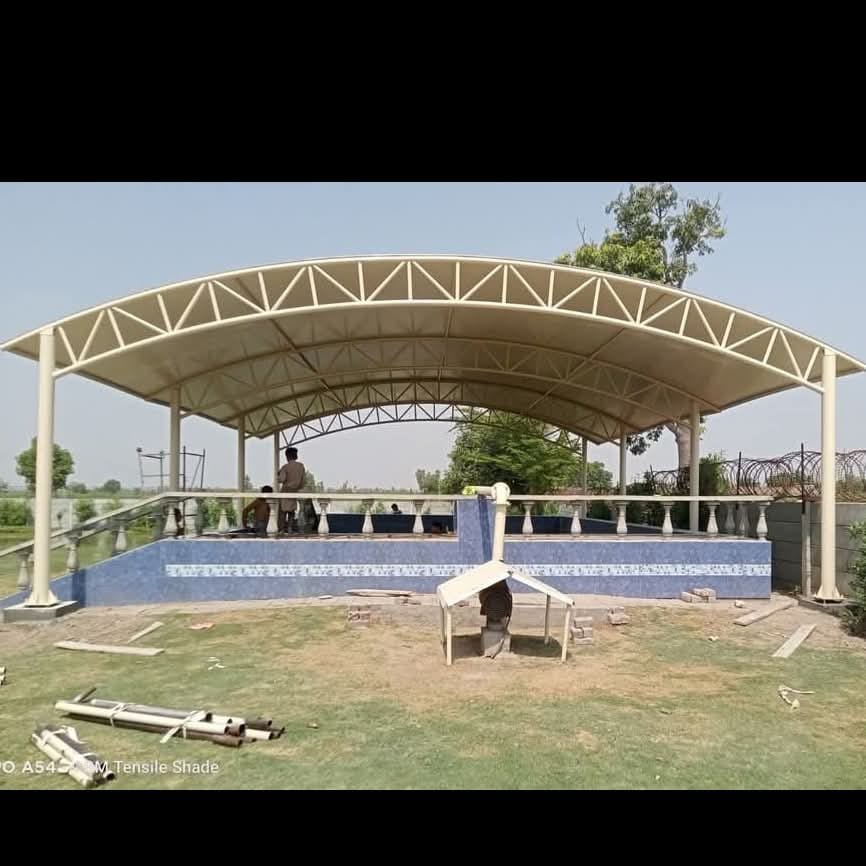
King Fahd Stadium, the Munich Olympic Park and the Tokyo Dome prove that fabric can cover spectators and even entire fields. For schools, clubs and academies in Pakistan, a cantilevered stand canopy or a tensile cover over a cricket net, futsal court or swimming pool delivers similar benefits on a modest budget.
Religious and Community Spaces
The umbrellas at Masjid an-Nabawi are among the most loved tensile structure examples in the world. Mosques, madrasas, Eidgahs and community halls can use courtyard umbrellas, fixed cone canopies or walkway covers to shade worshippers during Friday prayers, Eid congregations and large gatherings.
Commercial and Hospitality
The O2 and Canada Place show how a fabric roof becomes part of a brand. Hotels, restaurants, malls and showrooms use sculptural canopies at entrances, drive-throughs and outdoor seating to attract customers while keeping them cool.
Residential and Housing Societies
At home, the most practical tensile structure examples are car porches, rooftop shades, lawn gazebos and pool covers. Housing societies use them for gate entrances, parks, parking areas and playgrounds. See our guide to rooftop tensile shades in Pakistan for ideas sized for homes.
Frequently Asked Questions
What is the most famous tensile structure in the world?
The Munich Olympic Park roof and the Millennium Dome (The O2) in London are usually named first. In the Muslim world, the Hajj Terminal in Jeddah and the umbrellas of Masjid an-Nabawi in Madinah are the best-known tensile structure examples.
Which material is used in most large tensile roofs?
PTFE-coated glass fibre is used in many large permanent roofs because it lasts for decades and resists UV. ETFE foil is used where high light transmission is needed. PVC-coated polyester is common for medium and small projects.
How long do tensile structures last?
It depends on the membrane. Well-maintained PTFE glass fibre roofs often last 25 to 30 years or more, ETFE systems are expected to last a similar period, and good-quality PVC/PVDF fabrics typically last 10 to 20 years.
Are tensile structures suitable for Pakistan’s climate?
Yes. Many of the world’s best tensile structure examples are in hot desert climates such as Saudi Arabia. With the right fabric, correct pre-stress and wind-designed anchors, tensile roofs perform very well in Pakistani heat, monsoon rain and dust storms.
Can I get a small project designed like these famous examples?
Absolutely. The same principles scale down to car parks, courtyards, rooftops and cafés. Imperial Tensiles designs, fabricates and installs custom tensile shades across Pakistan.
Conclusion
From Munich to Madinah, the world’s best tensile structure examples prove that a carefully shaped membrane can shade thousands of people, light huge halls and become a symbol of a city. The same science can protect your cars, students, customers or family. If you want a canopy inspired by these landmarks, contact Imperial Tensiles for a site survey, design and free quotation.
Further reading: the Designing Buildings guide to tensile structures gives a helpful technical overview.